
Montevista | Jewish Burial Customs: Timing, Caskets, and Cemetery Requirements
Jewish Burial Customs: Timing, Caskets, and Cemetery Requirements


Jewish burial customs are governed by halacha (Jewish religious law) and centuries of tradition. While practices vary across Orthodox, Conservative, and Reform movements, core requirements regarding burial timing, casket specifications, and cemetery practices remain largely consistent. Understanding these detailed requirements helps Jewish families plan funerals that honor their traditions and helps funeral directors and cemeteries serve Jewish families appropriately.
The Requirement for Prompt Burial
Jewish law requires burial as soon as practically possible after death, ideally within 24 hours.
The 24-Hour Principle
Biblical basis: The Torah commands, “You shall bury him the same day” (Deuteronomy 21:23), establishing prompt burial as a religious obligation.
Reasons for quick burial:
Respect for the deceased (kavod hamet): Jewish tradition teaches that leaving a body unburied shows disrespect to the deceased.
Preventing decomposition: In ancient times before modern refrigeration, prompt burial was practical in hot climates.
Spiritual belief: Some Jewish teachings suggest the soul remains near the body after death, unable to fully transition until burial occurs.
Closure for mourners: Quick burial helps survivors begin the grieving process without prolonged limbo.
When Delays Are Permitted
While 24-hour burial is the ideal, Jewish law recognizes circumstances requiring delays:
Shabbat and holidays: Burials cannot occur on Shabbat (Friday sunset through Saturday sunset) or major Jewish holidays (Rosh Hashanah, Yom Kippur, Sukkot, Passover, Shavuot). The body remains prepared but unburied until the holy day ends.
Waiting for family: If immediate family members (children, parents, siblings, spouse) must travel from distant locations, burial may be delayed to allow their attendance. Reform and some Conservative rabbis allow longer delays than Orthodox authorities.
Legal requirements: Autopsies, investigations, or paperwork required by civil authorities may necessitate delays.
Chevra Kadisha availability: If the burial society cannot perform tahara (ritual purification) immediately, burial must wait.
Finding a rabbi: If the family’s rabbi is unavailable and they need time to find someone to officiate.
Most Jewish families still strive to bury within 48-72 hours even when 24 hours isn’t possible. Delays beyond a few days are unusual except in extraordinary circumstances.
Jewish Casket Requirements
Jewish burial traditions emphasize simplicity and equality, reflected in specific casket requirements.
Orthodox and Conservative Requirements
All-wood construction: The casket must be made entirely of wood with no metal parts whatsoever—no nails, screws, hinges, or metal handles. Wood pegs or glue hold the casket together.
Reasoning: Metal doesn’t decompose and delays the body’s natural return to earth. Wood is organic and biodegradable, fulfilling the biblical principle “for dust you are, and to dust you shall return” (Genesis 3:19).
Simple design: Elaborate caskets, expensive woods, and decorative elements are discouraged. All Jews are equal in death, and expensive caskets create inappropriate class distinctions.
No interior lining: Traditional Jewish caskets have no satin, velvet, or cushioned linings. The body rests directly on the wood.
Bottom holes: Some very traditional caskets have holes drilled in the bottom to ensure direct contact between the body and earth.
Jewish casket features: – Plain pine or other simple wood – Basic rectangular shape – Wooden pegs instead of metal fasteners – Simple rope or wooden handles – Star of David may appear on the exterior
Reform Approaches
Reform Judaism allows more flexibility:
Metal caskets permitted: While not encouraged, Reform Jews may choose metal caskets if desired.
More decorative options: Reform families sometimes select more elaborate caskets, though simplicity remains a valued principle.
Practical considerations: Reform communities recognize that some cemeteries require outer burial containers (vaults), and that modern funeral practices differ from ancient customs.
Even within Reform Judaism, many families choose simple wooden caskets to honor tradition and the principle of equality.
Open vs. Closed Casket
Orthodox: Always closed casket. Viewing the deceased is generally discouraged after preparation, as it’s considered disrespectful to observe the deceased in their vulnerable state.
Conservative: Generally closed casket, though some Conservative communities allow brief family viewing before the service.
Reform: May have open or closed casket based on family preference, though closed is still more common.
When viewing occurs, it’s usually limited to immediate family and occurs privately before the funeral service, not during it.
Jewish Cemetery and Burial Requirements
Jewish cemeteries and burial practices follow specific traditions ensuring proper observance of Jewish law.
Cemetery Considerations
Jewish sections or cemeteries: Orthodox and most Conservative Jews prefer burial in designated Jewish cemeteries or Jewish sections of non-denominational cemeteries.
Consecration: Traditional Jewish burial grounds are consecrated according to Jewish law, setting them apart as sacred space.
Perpetual care: Jewish tradition emphasizes eternal rest—burial plots should be permanent, never disturbed or reused.
Visitation: Jewish cemetery tradition includes visiting graves to honor the deceased, pray, and maintain connection to ancestors.
Burial Position and Orientation
Facing Jerusalem: Traditional Jewish burial positions the deceased facing Jerusalem (the location of the Temple). In California, this typically means facing east or slightly northeast.
Body position: The deceased is buried lying on their back with arms at their sides, hands positioned as if in prayer or rest.
Head positioning: The head is typically at the west end of the grave so the deceased faces east/Jerusalem.
Direct Earth Burial
Traditional preference: Jewish law strongly prefers placing the body directly in the earth without an outer container, allowing natural decomposition.
“Earth to earth”: This practice fulfills the biblical teaching about returning to earth and emphasizes the temporary nature of the physical body.
Modern challenges: Many cemeteries require outer burial containers (burial vaults or grave liners) to prevent ground settling and simplify maintenance.
Compromise solutions: Some cemeteries offer vault alternatives: – Vaults with removable bottoms allow the body to rest directly on earth – Vaults can be positioned with gaps allowing earth contact – Natural burial sections may allow vault-free burial
Monte Vista can work with Jewish families to honor traditional preferences while meeting cemetery operational requirements.
Grave Depth and Structure
Depth requirement: Jewish graves should be deep enough that scent cannot emerge and animals cannot disturb the remains. Traditional depth is approximately six feet.
Single-depth burial: Each person receives their own grave. Stacking multiple caskets in one plot is not permitted in traditional Jewish law.
Couple burial: Married couples may be buried side by side in adjacent plots.
Filling the Grave
Sacred act (chesed shel emet): Filling the grave is considered a “true kindness” because the deceased cannot repay it. This makes it one of the most meaningful mitzvot (good deeds).
Community participation: Family members, friends, and attendees take turns placing shovelfuls of earth into the grave.
Symbolism of the shovel: Some traditions involve turning the shovel upside down when placing earth, or setting it in the ground rather than handing it directly to the next person. This symbolizes reluctance to pass along this sad task.
Complete filling: Traditionally, the grave should be completely filled during the funeral, not left for cemetery workers to finish later. The community remains until the grave is filled, creating a mound over the top.
Sound of earth: The sound of earth falling on the wooden casket provides a powerful moment of finality, helping mourners accept the reality of death.
Grave Markers and Memorialization
Jewish tradition includes specific customs for marking graves and honoring the deceased.
Unveiling the Headstone
Timing: Headstones are typically installed and formally unveiled 11-12 months after death, coinciding with the end of the mourning period.
Unveiling ceremony: A brief service at the grave includes prayers, psalms, and removal of the cloth covering the new headstone. Family and close friends attend.
Alternate timing: Some families unveil stones earlier (after 30 days, or at other intervals), especially if traveling from far away. Local customs vary.
Headstone Design
Simplicity: Traditional Jewish headstones are simple and uniform, reflecting the principle of equality.
Hebrew and English: Most contemporary Jewish headstones include both Hebrew and English text.
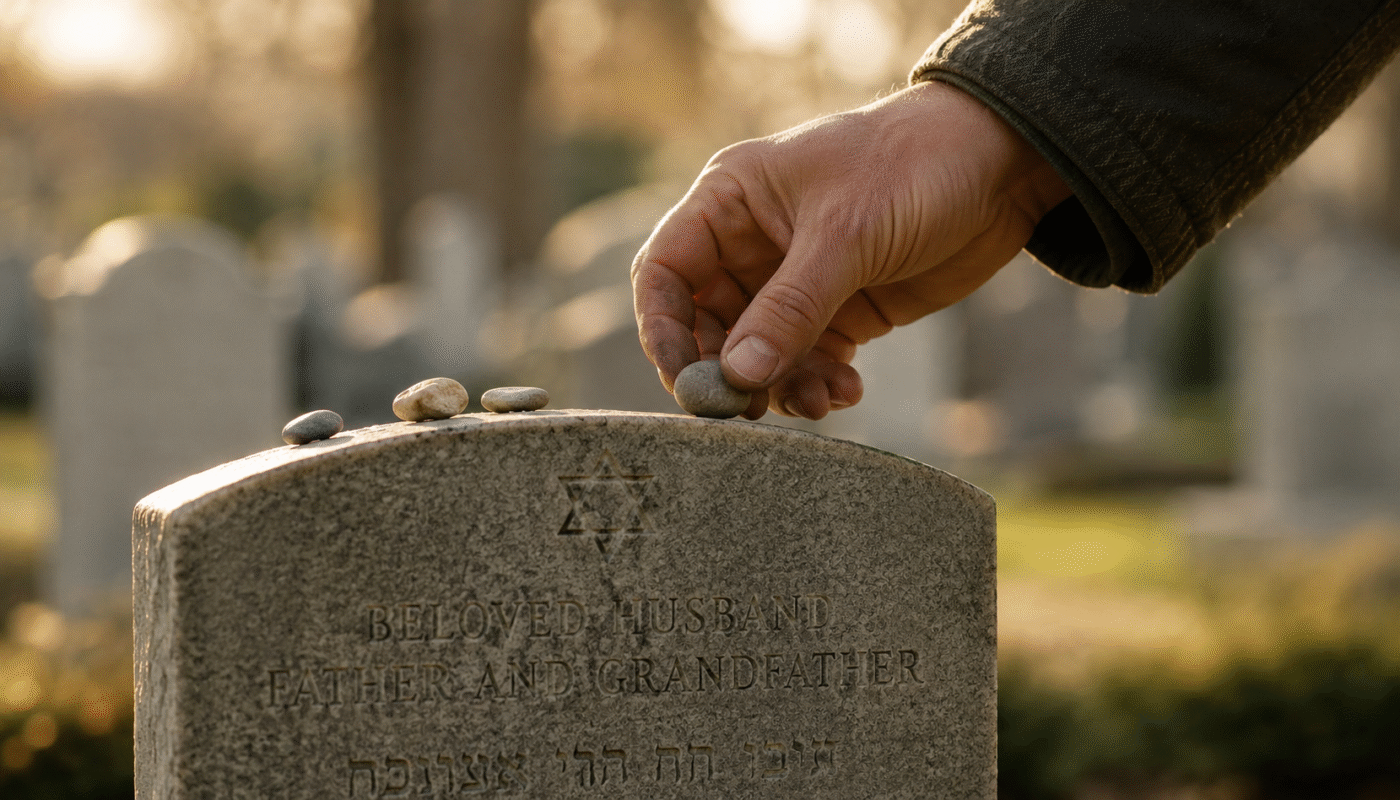
Star of David: Many Jewish headstones feature the Star of David symbol.
Information included: – Full name in English and Hebrew – Birth and death dates (both secular calendar and Hebrew calendar) – Hebrew phrase “Here lies” or “In memory of” – Brief inscription about the person’s character or roles – Common Hebrew abbreviations like ת.נ.צ.ב.ה (May their soul be bound in the bond of eternal life)
Photos: Some Jewish communities allow photos on headstones; others find this practice inappropriate. It varies by tradition and community custom.
Visiting Graves
Yahrzeit: Family members visit on the anniversary of death to recite Kaddish and leave stones (a traditional Jewish custom instead of flowers).
Before holidays: Some Jews visit family graves before major holidays like Rosh Hashanah.
Stone placement: Visitors leave small stones on headstones as a sign that someone visited and remembers. This ancient custom predates the use of flowers.
Variations Across Jewish Movements
While core burial customs remain consistent, different Jewish movements interpret and apply some requirements differently.
Orthodox Practices
- Strict adherence to 24-hour burial when possible
- All-wood caskets with no metal
- Closed caskets always
- No embalming except when legally required
- Men buried in tallit (prayer shawl), women in simple shrouds
- Burial only in consecrated Jewish cemeteries
- Traditional grave filling by community
Conservative Practices
- Generally follow traditional timing and casket requirements
- Some flexibility on viewing and timing
- Accept cemetery compromises when necessary
- Balance tradition with contemporary realities
- Usually use all-wood caskets
- Prefer Jewish cemetery sections
Reform Practices
- More flexible timing allowing family gathering
- Accept metal caskets though wood preferred
- May allow open caskets if family wishes
- Embalming permitted if necessary
- Focus on dignity and kavod hamet rather than specific technical requirements
- Burial in any respectful cemetery acceptable
- Adapt traditions while honoring underlying values
Serving Jewish Families at Monte Vista
Monte Vista Memorial Gardens serves Bay Area Jewish families across all movements with burial plots and burial practices that can honor Jewish traditions. Monte Vista plans to offer a dedicated Jewish burial section as the cemetery develops, and our team can work with families and Chevra Kadisha groups to coordinate tahara at appropriate off-site facilities.
We understand the importance of prompt burial and coordinate efficiently to accommodate the 24-hour ideal whenever possible. Our staff works knowledgeably with all-wood kasher caskets, proper grave orientation toward Jerusalem, and traditional grave-filling customs. We accommodate requests for direct earth burial where possible and work creatively with families seeking traditional practices within modern cemetery operations.
Whether your family follows Orthodox, Conservative, or Reform traditions, Monte Vista provides respectful, knowledgeable support that honors your commitment to Jewish burial customs.
Key Takeaways
Understanding Jewish burial customs helps families honor these sacred traditions:
-
Prompt burial: Jewish law requires burial within 24 hours when possible, though reasonable delays are permitted for Shabbat, holidays, or family travel.
-
Simple wooden caskets: Traditional Jewish caskets are all-wood with no metal parts, emphasizing simplicity, equality, and natural decomposition.
-
Grave orientation: The deceased faces Jerusalem (typically east/northeast in California), maintaining spiritual connection to the Holy Land.
-
Community participation: Filling the grave is a sacred communal act, with family and friends taking turns placing earth in the grave.
-
Movement variations: Orthodox, Conservative, and Reform Judaism interpret requirements differently while maintaining core principles of respect and dignity.
Questions About Jewish Burial Customs
Monte Vista Memorial Gardens provides knowledgeable support for Jewish families navigating burial customs and requirements. Our experienced staff understands Jewish law and works respectfully with families and rabbis to honor traditions.
Call 510-299-1174 to discuss Jewish burial arrangements and how Monte Vista can serve your family’s needs.